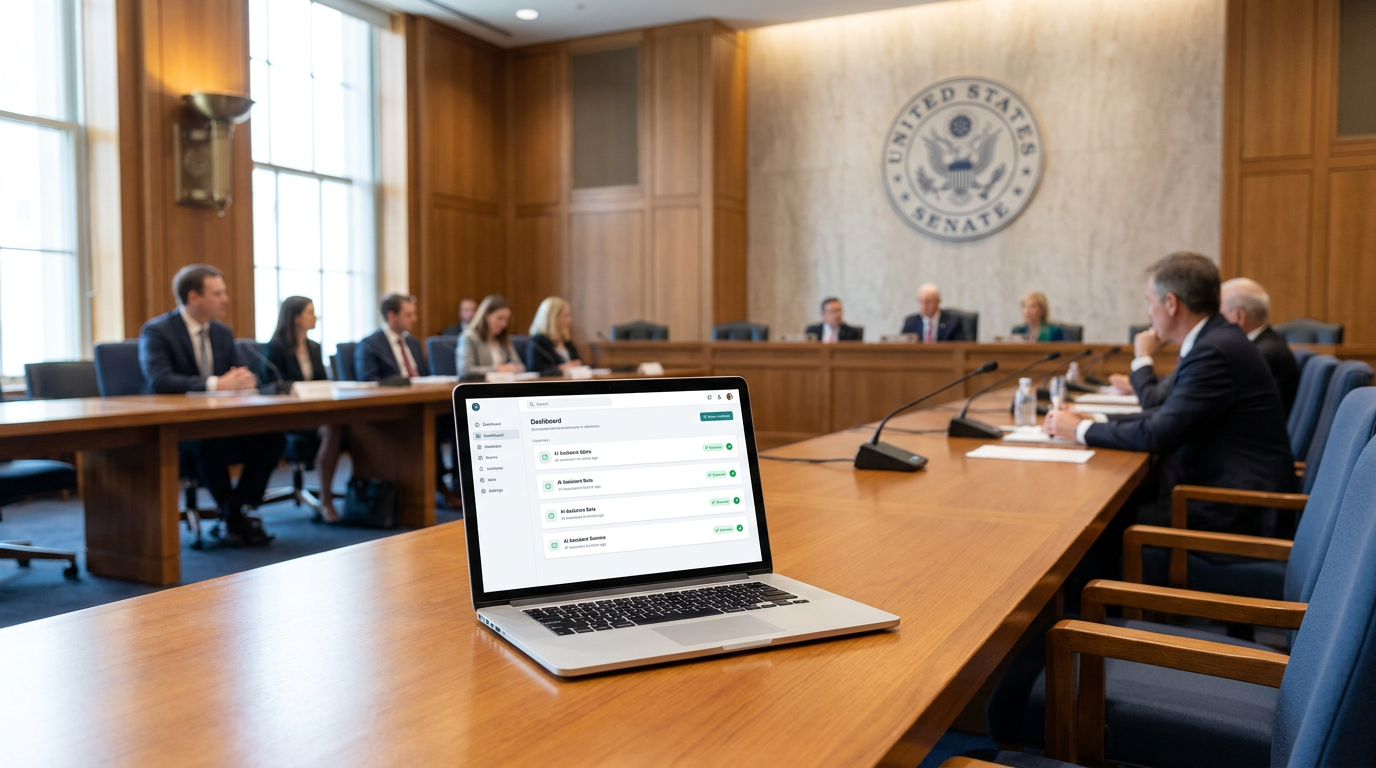
On June 29, 2026, Senator Mark Warner (D-VA) released a discussion draft of the Artificial Intelligence Access, Gatekeeper Exchange, and Nondiscriminatory Transfer Act, shortened to the AI AGENT Act. It is one of the first serious attempts in Congress to write rules for the software agents that are starting to book travel, shop, and manage money on people's behalf.
The draft is not law yet. Warner released it to collect feedback before formally introducing a bill. But the direction is clear, and it matters to any company that builds or deploys AI agents, because the core idea is a federal registry that decides which agents are trusted enough to act for a user.
What the draft actually proposes
According to Warner's office, the AI AGENT Act would do five things. It would set rights and responsibilities for secure agent access to large online platforms. It would create a Federal Trade Commission registry of trusted, secure AI agents. It would require agents to protect a user's privacy and data, act transparently in the user's best interest, and prove to third-party services that they have valid authorization. It would direct the National Institute of Standards and Technology (NIST) to define technical standards and open protocols, including for authentication. And it would protect businesses and users from agent abuse or misuse.
In Warner's words: "As agentic AI transforms how Americans interact with technology, consumers deserve a real choice in the marketplace, and AI agents must be accountable to the people they serve." He called the draft "a major step toward building a clear federal framework" and said he is releasing it to hear from stakeholders "before it is formally introduced."
A registry, plus a duty to the user
The mechanism is a vetted list. As CyberScoop reported, the FTC would certify independent bodies to check agent vendors against baseline protections for privacy, data security, and user interest, then list the ones that pass. Providers would register before their agent could act as a user's representative, and each agent would be tied to the identity of its human operator. The FTC could remove violators from the list, though the draft does not let it bar platforms from using unlisted agents outright.
There is also a fiduciary flavor. CBS News notes the draft holds that an agent with access to a user's most sensitive accounts, email, e-commerce, and credit cards, should behave in a fiduciary-like manner. That is a higher bar than "do not be negligent." It means the agent is expected to put the user's interest first, by design.
Interested in implementing similar AI solutions? Discover how PATech Labs can help your business leverage cutting-edge artificial intelligence.
Learn About Our ServicesThe 50 million user line
The obligations on platforms kick in at scale. The draft aims at large online platforms, described as those with more than 50 million United States customers or subscribers. Those platforms would have to keep an interoperable interface so registered agents can act for users in a fair and functionally equivalent way, rather than quietly steering people toward the platform's own tools. The stakes are not small: CBS cites a Morgan Stanley estimate that AI shopping assistants could account for up to 385 billion dollars of United States e-commerce sales by 2030.
What this means for banks, clinics, and call centers
Here is the practical read from where we sit at PATech, building voice agents and agent workflows for real operators. Whatever the final text looks like, three requirements in this draft are already good engineering, and worth building now rather than retrofitting later.
First, identity binding. If every agent has to be linked to a human operator, you want a clean record of who authorized the agent and for what scope. Build that mapping into the system from day one. Second, a real-time action log. The draft expects agents to maintain records of what they did on a user's behalf. A voice agent that books an appointment or moves a payment should write an auditable trail as it acts, not reconstruct it later. Third, consent and revocation that a normal person can use. "Scope-limited and revocable" only means something if a caller can grant or pull an agent's permission without a support ticket.
For a bank, a clinic, or a call center, none of this is exotic. It is the difference between an agent you can defend to a regulator and one you cannot. We already treat auditability, authorization, and clear consent as core parts of a production voice-agent workflow, because customers ask for it long before a statute does.
Where it stands
The AI AGENT Act is a discussion draft, open for public comment, not a passed law. It may change a lot before it is introduced, and more before it becomes anything binding. But the signal is worth reading plainly: Washington now treats AI agents as infrastructure that needs identity, oversight, and a duty to the user. Teams that build for those requirements today will have less to rewrite when the rules land.